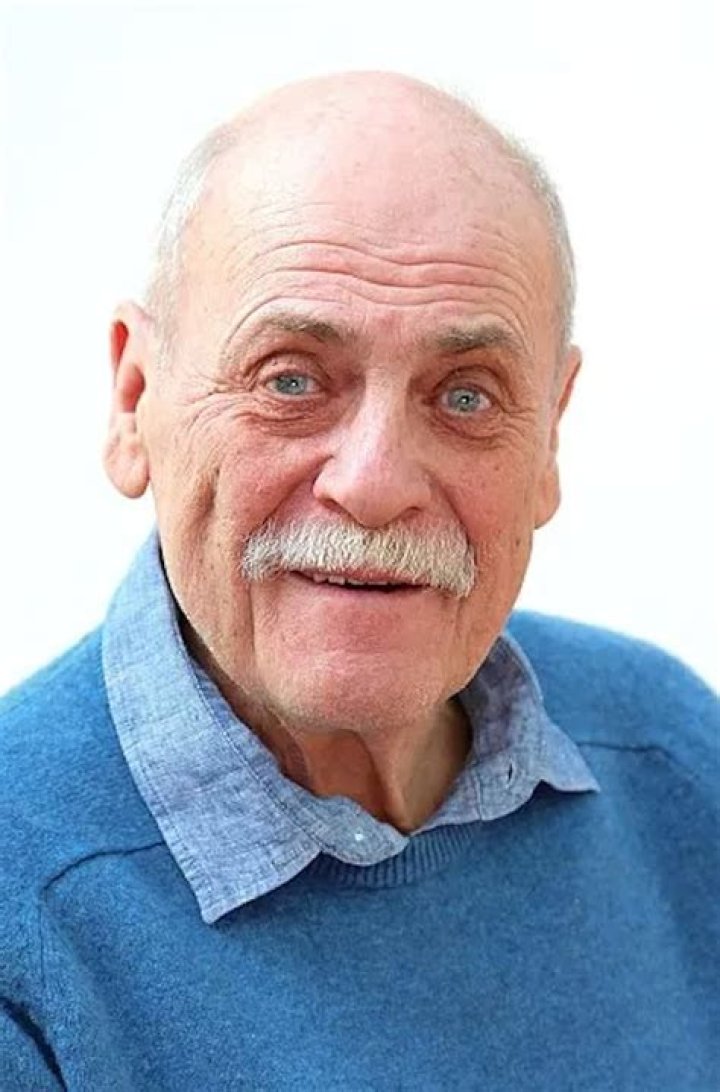
Age, Biography and Wiki
Bogdan Bogdanović (architect) was born on 20 August, 1922 in Belgrade, Kingdom of Serbs, Croats and Slovenes, is an architect. Discover Bogdan Bogdanović (architect)'s Biography, Age, Height, Physical Stats, Dating/Affairs, Family and career updates. Learn How rich is He in this year and how He spends money? Also learn how He earned most of networth at the age of 88 years old?
| Popular As | N/A |
| Occupation | N/A |
| Age | 88 years old |
| Zodiac Sign | Leo |
| Born | 20 August, 1922 |
| Birthday | 20 August |
| Birthplace | Belgrade, Kingdom of Serbs, Croats and Slovenes |
| Date of death | (2010-06-18) Vienna, Austria |
| Died Place | Vienna, Austria |
| Nationality | Serbia |
We recommend you to check the complete list of Famous People born on 20 August. He is a member of famous architect with the age 88 years old group.
Bogdan Bogdanović (architect) Height, Weight & Measurements
At 88 years old, Bogdan Bogdanović (architect) height not available right now. We will update Bogdan Bogdanović (architect)'s Height, weight, Body Measurements, Eye Color, Hair Color, Shoe & Dress size soon as possible.
| Physical Status | |
|---|---|
| Height | Not Available |
| Weight | Not Available |
| Body Measurements | Not Available |
| Eye Color | Not Available |
| Hair Color | Not Available |
Dating & Relationship status
He is currently single. He is not dating anyone. We don't have much information about He's past relationship and any previous engaged. According to our Database, He has no children.
| Family | |
|---|---|
| Parents | Not Available |
| Wife | Not Available |
| Sibling | Not Available |
| Children | Not Available |
Bogdan Bogdanović (architect) Net Worth
His net worth has been growing significantly in 2022-2023. So, how much is Bogdan Bogdanović (architect) worth at the age of 88 years old? Bogdan Bogdanović (architect)’s income source is mostly from being a successful architect. He is from Serbia. We have estimated Bogdan Bogdanović (architect)'s net worth , money, salary, income, and assets.
| Net Worth in 2023 | $1 Million - $5 Million |
| Salary in 2023 | Under Review |
| Net Worth in 2022 | Pending |
| Salary in 2022 | Under Review |
| House | Not Available |
| Cars | Not Available |
| Source of Income | architect |
Bogdan Bogdanović (architect) Social Network
| Wikipedia |
| Imdb |
Timeline
Bogdanović died in a hospital in Vienna on 18 June 2010, following a heart attack. He was cremated in Vienna, and his urn was sent to Belgrade. Although the city offered a grave for him in the Alley of the Greats at the Belgrade New Cemetery, upon his wife's request, and the approval of the Jewish community, Bogdanović's remains have been placed in the Sephardic cemetery where his monument to the Jewish victims of fascism and fallen soldiers stands.
In 1993, Bogdanović went into self-imposed exile to Paris with his wife Ksenija. However, since the Yugoslav émigré circle there had strong nationalistic tendencies, the couple moved on to settle in Vienna upon invitation of his friend, the writer and translator Milo Dor.
After his term of office, he was appointed by Slobodan Milošević as a member of the Central Committee of the League of Communists of Yugoslavia, the party's supreme governing body. He accepted the post under the condition that he would not be required to attend committee meetings because he "had more important things to do". In the following year he sent Milošević an anti-nationalist letter over 60 pages long, including a Stalino-dictionary, an appendix satirising the recipient's nationalist rhetoric, and the famous Lamentation for Serbia, which discussed the theme of Serbia "being tired" (of its leaders). The Central Committee replied, "You can send the letter, in which you criticise the work of the eighth meeting and which has not reached us, to the Central Committee if you consider it necessary". The letter, in combination with other remarks about Milošević, led to attempts of breaking into Bogdanović's apartment, death threats, and his exclusion from the Central Committee. This, however, did not prevent him from renewing his anti-nationalist statements when the Yugoslav wars started at the beginning of the 1990s, once more turning Bogdanović into a target for violent attacks and a defamation campaign run by the Serbian state media.
Bogdanović was a founder member of the International Academy of Architecture which was established in 1987 and a foreign member of the Russian Academy of Architecture (from 1994), a corresponding member of the Bavarian Academy of Fine Arts (from 1998), and a member of the Collegium Europaeum Jenense (University of Jena; from 2000). In 2002 he was elected an honorary member of the Academy of Sciences and Arts of Bosnia and Herzegovina.
Being an ardent leftist, Bogdanović opposed the increasing nationalism espoused by state leaders since the early 1980s. Nonetheless, he became Mayor of Belgrade in 1982 on the initiative of Ivan Stambolić, then chairman of the League of Communists of Serbia. Bogdanović served one term in office, until 1986. During this time, he organised an international competition for the complete redevelopment of New Belgrade, a planned area on the left bank of the Sava river. All submissions to this competition have since disappeared.
In 1976, he began to teach in an abandoned village school in Mali Popović near Belgrade to realise an alternative project, namely his "village school for the philosophy of architecture". The course was called Symbolic forms in allusion to Ernst Cassirer, had no fixed timetable and employed the invention of new writing systems, the interpretation of non-existent texts, as well as methods akin to free association and gematria. Fourteen years later, when henchmen of Milošević raided the school in the aftermath of Bogdanović's letter, much of the collected material – the documentation of the lessons, drawings, audio- and videotapes, optical devices – was destroyed.
At the University of Belgrade, Bogdanović held the lecture course The development of housing schemes (later called History of town), starting in 1962. As professor and dean, he tried to reform the teaching of architecture and introduce grassroots democracy at the university, but the party forced him to abdicate before he could put his plans into practice.
Other works of architecture include the reconstruction of the villa of Queen Natalija (Smederevo, 1961), Adonis' altar (Labin, 1974) and the Tomb of Dušan Petrović-Šane (Aranđelovac, 1980).
Bogdanović refused to participate in the planning of national housing estates which looked like "coffins of concrete" to him and had "only two types of windows". Consequently, he built only a single settlement: a housing estate for the hydrotechnical institute "Jaroslav Černi" at the foot of the mountain Avala near Belgrade, finished in 1953. The houses are mostly built of stone; and with their surrealistic, old-fashioned style, heavily framed windows and oversized chimneys, they are deliberately set apart from the international style that dominated in post-WW2 Yugoslavia.
In 1951, Bogdan Bogdanović won a competition for the design of a memorial to the Jewish victims of fascism, to be built on the Sephardic cemetery in Belgrade. Although not religious himself, this contact with Jewish esotericism strongly influenced his further work. From then on until 1981, he was assigned by Josip Broz Tito to devise more than 20 monuments and memorial places against fascism and militarism, which were erected in all republics of Yugoslavia. To work as cenotaphs for all victims of fascism, regardless of nationality and religion, they lack any symbols of communism or other ideologies. Instead, they rely on archaic, mythological forms, sharply contrasting with the principles of Socialist realism. This contrast also served Tito's wish to emphasise his country's independence from the Soviet Union.
Bogdanović is best known for designing monuments and memorials commemorating victims and resistance fighters of World War II built all over Yugoslavia from the early 1950s to the 1980s. In particular, the monumental concrete sculpture titled Stone Flower near the site of Jasenovac concentration camp gained international attention.
Beginning in 1940, Bogdan studied architecture at the University of Belgrade. He participated in World War II ("a bit" in his words) as a partisan, becoming a member of the Communist Party, and was seriously wounded in eastern Bosnia. Despite his injuries, he continued his academic career after the war, graduating in 1950, becoming a teaching assistant at the department for urbanism (from 1953), then a docent in 1960, extraordinary professor and president of the Yugoslav Union of Architects in 1964, dean of the Faculty of Architecture and a corresponding member of the Serbian Academy of Sciences and Arts (SANU) in 1970, and full professor in 1973. In 1981 he resigned from SANU, and he was conferred emeritus status in 1987.
Bogdan Bogdanović (Serbian Cyrillic: Богдан Богдановић; 20 August 1922 – 18 June 2010) was a Serbian and Yugoslav architect, urbanist and essayist. He taught architecture at the University of Belgrade Faculty of Architecture, where he also served as dean. Bogdanović wrote numerous articles about urbanism, especially about its mythic and symbolic aspects, some of which appeared in international journals such as El País, Die Zeit, and others. He was also involved in politics, as a Yugoslav Partisan in World War II, later as mayor of Belgrade. When Slobodan Milošević rose to power and nationalism gained ground in Yugoslavia, Bogdanović became a dissident.